Vadzo Imaging Validates 850nm and 940nm NIR Response on Innowave-2020CRS: Onsemi 20MP AR2020 Color GigE WIFI Camera for Near Infrared Imaging
The Innowave-2020CRS is an Onsemi 20MP AR2020 Color GigE Wi-Fi camera, and Vadzo Imaging has validated its
Press Release Disclaimer: This is a press release distributed through the XPR Media network. It has not been independently verified by our newsroom.


The Innowave-2020CRS is an Onsemi 20MP AR2020 Color GigE Wi-Fi camera, and Vadzo Imaging has validated its near-infrared response at 850nm and 940nm. A camera that works at night has to do two opposite things. By day it must block infrared light so that colors look right, and by night it must let infrared light through so that an infrared illuminator can light the scene without being seen or without disturbing anyone. The Innowave-2020CRS handles both with an M12 lens mount and an electromechanical IR cut filter. As a 20MP NIR GigE Wi-Fi camera, it keeps 20MP detail in the near-infrared band, and it adds Gigabit Ethernet and dual-band Wi-Fi, ONVIF, IEEE 1588 PTP, onboard storage, unicast and multicast streaming, and an onboard dewarping engine for lenses up to 200 DFOV. High dynamic range up to 100 dB helps with scenes that mix bright and dark regions. Designed for surveillance, medical, automation, and retail systems, it brings day and night imaging to flexible networks.
FORT WORTH, TX / ACCESS Newswire / October 28, 2026 / Vadzo Imaging, a provider of embedded vision camera products for OEMs and system integrators, today announces validation of 850nm and 940nm near infrared response on the Innowave-2020CRS, an AR2020 Color GigE WIFI Camera built on the Onsemi AR2020 sensor. Part of Vadzo’s network camera portfolio, the Innowave-2020CRS combines Gigabit Ethernet and dual-band Wi-Fi, ONVIF compliance, IEEE 1588 PTP synchronization, onboard storage, and an M12 lens mount with an electromechanical IR cut filter. With this validation, Vadzo presents a 20MP NIR GigE WIFI Camera for smart surveillance, medical, automation, and retail systems, together with guidance on choosing between 850nm and 940nm illumination, handling the lens in the infrared band, and planning day and night operation.
Why an AR2020 Color GigE WIFI Camera Needs Day and Night IR Control
Silicon sees more than people do. A color image sensor responds to near infrared light, which the eye cannot see, and that response is both an opportunity and a nuisance. It is an opportunity because infrared illuminators can light a scene at night without visible light, which suits surveillance, inspection, and instruments that must not disturb a subject. It is a nuisance by day, because the infrared that reaches the sensor washes out colors and shifts whites. Camera units that must serve both conditions need a way to block the infrared when it does harm and to admit it when it helps. A dual-purpose camera therefore needs a dependable switching design.
The usual answer is an IR cut filter that moves in and out of the light path. By day it sits in front of the sensor and removes the infrared, and by night it moves aside. Making that work in a real product raises several questions. The mechanism must be reliable over many thousands of cycles. The camera must decide when to switch, and the image must stay usable during the change. At night, the color filters on the sensor no longer separate colors, so the picture is effectively monochrome, and automatic white balance has nothing useful to do. Teams that expect a colorful night image are disappointed, and teams that plan for a monochrome one are not. Setting that expectation early avoids disputes at acceptance time.
The wavelength matters as well. Infrared illuminators come in different bands, most often 850nm and 940nm, and they behave differently. An 850nm source gives the sensor a stronger signal but shows a faint red glow. A 940nm source is invisible but yields a weaker signal, and sunlight contains less energy at that wavelength, which helps outdoors. Lenses also focus infrared light at a slightly different distance from visible light, so a fixed focus lens tuned for daylight can be soft at night. A camera that advertises near-infrared sensitivity without discussing these points leaves the designer to learn them in the field. A short night test on the real site is worth more than any specification.
Networking adds its own questions. Night camera units sit in places that are hard to cable, and a camera that offers both Gigabit Ethernet and Wi-Fi can serve them, but the links behave differently, and a 20MP stream is large. Reliability matters most at night, when an event is rare and valuable, and a camera that loses footage when the link drops fails at the worst time. Local recording and a wired path for the full stream are the usual remedies.
How the Innowave-2020CRS Supports 850nm and 940nm Near-Infrared Imaging
The Innowave-2020CRS is built on the Onsemi AR2020, a 20MP (5120 x 3840) color rolling shutter sensor with a 1/1.8 inch optical format and 1.4 micron pixels. The sensor is a low-noise CMOS design with enhanced dynamic range and excellent near-infrared sensitivity, and Vadzo has validated the response at 850nm and 940nm. The camera uses an S-Mount (M12) lens holder with an electromechanical IR cut filter, which blocks infrared by day for true color and moves aside at night so that the sensor can use infrared illumination. The 20MP frame leaves room to crop and zoom into a region of interest after an event.
A color sensor sees infrared through its color filters. At wavelengths beyond roughly 800nm, the red, green, and blue filters all become largely transparent, so every pixel responds to infrared in a similar way and the color information is lost. This is why a night image from a color camera looks monochrome, and why the camera needs the IR cut filter for daytime color. Near infrared light also penetrates deeper into silicon than visible light before it is absorbed, which can reduce contrast at very fine detail on a small pixel. The effect depends on the sensor design, and it is a reason to validate response at the actual wavelengths, as Vadzo has done, instead of relying on a single test point. Vadzo validated the response at both wavelengths for that reason.
Illumination choices follow from the sensor’s behavior. An 850nm illuminator gives a stronger signal and longer range, and it shows a faint red glow when viewed directly. A 940nm illuminator is invisible, which suits covert or comfort-sensitive uses, and it gives a weaker signal for the same electrical power, so it needs more illuminator output or a longer exposure. Sunlight contains less energy near 940nm because of absorption in the atmosphere, so a 940nm system sees less background in daylight, which helps outdoors. Teams should choose the band from the use case and test it on real scenes. A simple chart lit at each wavelength shows how sharp the image is in each band.
Lens choice matters because the optics are fixed focus. Glass focuses infrared at a slightly different distance than visible light, so a lens set in daylight can be soft at night. An infrared-corrected M12 lens reduces the shift, and a small focus compromise at the working distance often serves both conditions. The camera also offers Gigabit Ethernet with 100Base-T and 1000Base-T modes and dual-band Wi-Fi with 802.11a, b, g, n, and ac, plus ONVIF, PTP, onboard storage, unicast and multicast streaming, and an onboard dewarping engine for lenses up to 200 DFOV. The sensor’s high dynamic range, up to 100 dB, equals a brightness ratio of 100,000 to 1. Teams should confirm how the mode behaves with their own lens and lighting.
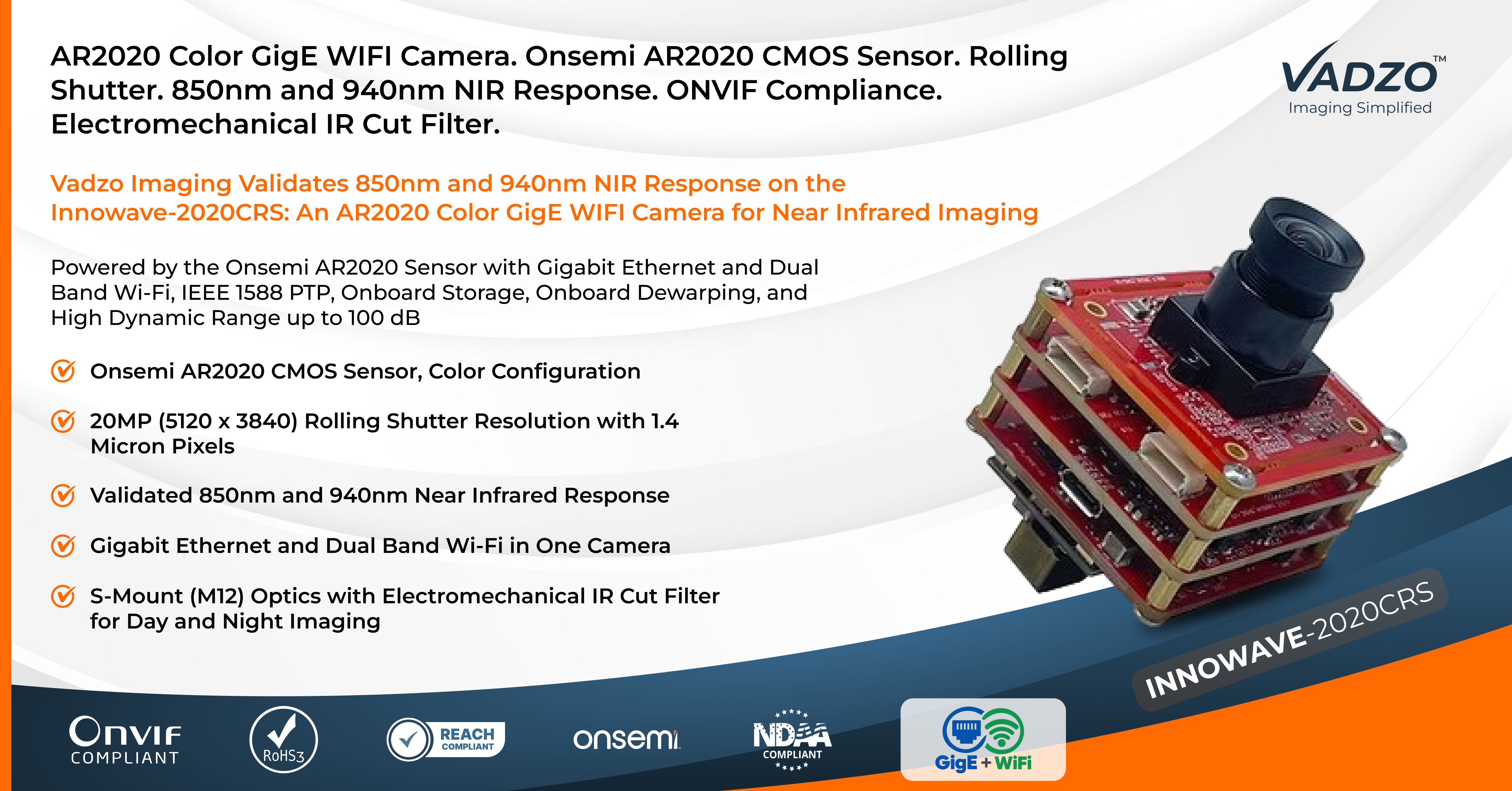
Product Overview
The Innowave-2020CRS is a 20MP color network camera built on the Onsemi AR2020 sensor with Gigabit Ethernet and Wi-Fi in one unit and validated near-infrared response. As a 20MP Near Infrared GigE WIFI Camera, it serves illuminated imaging at 850nm and 940nm, and as a 20MP NIR ONVIF GigE WIFI Camera, it works with standard video management software. The 20MP Near Infrared PTP GigE WIFI Camera designation covers IEEE 1588 synchronization across several camera units, and the 20MP NIR Unicast Multicast GigE WIFI Camera designation covers both streaming modes. The camera also serves as an AR2020 Near Infrared Ethernet WiFi Camera, a 20MP Near Infrared Ethernet WiFi Camera, an AR2020 Color NIR GigE WIFI Camera, a 20MP 850nm NIR GigE WIFI Camera, and a 20MP 940nm NIR Ethernet WiFi Camera for designs that need both links.
Key specs: 20MP (5120 x 3840) Max Resolution | Onsemi AR2020 1/1.8 inch Sensor Format | 1.4 micron Pixel | Color with Rolling Shutter | Gigabit Ethernet (100Base-T and 1000Base-T) and Dual Band Wi-Fi (802.11a/b/g/n/ac) | S-Mount (M12) Optics with Electromechanical IR Cut Filter
Key Capabilities of the AR2020 Color GigE WIFI Camera
Validated 850nm and 940nm Near-Infrared Response
The sensor responds well in the near infrared, and Vadzo has validated that response at 850nm and at 940nm, the two bands that most illuminators use. At 850nm the signal is stronger and the range longer, with a faint red glow from the source. At 940nm the illumination is invisible, with a weaker signal and less background from sunlight. Teams choose the band that suits the use case, and they should confirm range and image quality on their own scene with their own illuminator, including the farthest distance at which a subject must still be recognized. Illuminator placement also matters, since light placed close to the lens can cause glare from dust and insects at night.
Gigabit Ethernet and Dual-Band Wi-Fi Connectivity
One camera serves both wired and wireless sites. The Ethernet interface offers 100Base-T and 1000Base-T modes, and the Wi-Fi interface is dual-band, supporting 802.11a, b, g, n, and ac. Night installations are often hard to cable, so an installer can commission the unit wirelessly and then run it on a cable for the full 20MP stream, and a wireless link can keep the camera reachable if a cable fails. A 20MP Near Infrared Ethernet WiFi Camera of this kind means one part number, one set of spares, and one set of settings for mixed sites. Vadzo advises on how to divide traffic between the two interfaces for each design.
ONVIF Compliance for Network Video Integration
ONVIF is an industry standard that lets network video products from different makers work together. Because the camera complies with ONVIF, standard video management and recording software can discover it and request its video without custom code, which shortens commissioning in large sites. Teams should confirm the ONVIF features they need against the product documentation. Operators who manage many sites also gain from a single discovery method across all their camera units.
IEEE 1588 PTP for Multi-Camera Time Synchronization
When several camera units cover one scene, reviewers need recordings that line up in time. PTP, defined in IEEE 1588, synchronizes each camera clock to a network time source so frames share a common time base. The best accuracy comes on the wired link, because wireless delay varies, and teams should test the alignment on their real switches before a large rollout. A small pilot network is usually enough to reveal any issue before it affects many sites.
Onboard Recording During Network Interruptions
Networks drop packets and wireless links drop out. Onboard storage lets the camera keep recording locally while the link is down, so footage can be copied back afterward instead of being lost. An AR2020 NIR Onboard Storage GigE WIFI Camera and a 20MP NIR Onboard Storage GigE WIFI Camera suit sites with unreliable connections, where night events are rare and valuable. Teams should confirm the capacity and retrieval method for their design, and plan how long footage must be kept.
Unicast and Multicast Streaming for Networked Camera Systems
Unicast sends a separate stream to each viewer. Multicast sends one stream that the network copies to many viewers, which saves bandwidth when many clients watch the same camera. Multicast needs switches that support it, and over Wi-Fi it is usually sent at a low data rate that can slow the wireless network, so Vadzo recommends multicast on the wired link. An AR2020 NIR Multicast Ethernet WiFi Camera should be tested with the real network, since multicast support varies between switches and access points.
Onboard Dewarping for Ultra-Wide Lenses up to 200° DFOV
Very wide lenses capture a huge area and bend the picture strongly. The onboard dewarping engine flattens the image inside the camera for lenses up to 200 DFOV, so any client receives a usable view, and a 20MP NIR Dewarping Ethernet WiFi Camera keeps useful detail after correction. The correction is set for a particular lens, so teams choose the lens and the profile together, and they should confirm that the lens performs in the near infrared. Infrared-corrected lenses are available for M12 mounts, and Vadzo can help select one.
M12 S-Mount Optics with an Electromechanical IR-Cut Filter
The M12 lens mount accepts a wide range of lenses, so teams can choose the field of view and aperture for the site. The electromechanical IR-cut filter blocks near-infrared light by day, which keeps colors true, and moves out of the way at night, so the sensor can use infrared illumination. An infrared-corrected lens reduces the focus shift between visible and near-infrared light. As an AR2020 NIR Camera Manufacturer, Vadzo supports lens matching, firmware customization, and enclosure design for volume programs. Teams moving from evaluation to volume keep the same camera and documentation.
Up to 100 dB Dynamic Range for High-Contrast Scenes
Scenes that mix bright and dark regions, such as a lit doorway at night or a window behind a subject, push a normal exposure to clip one end or lose the other. The sensor’s high dynamic range, up to 100 dB, equals a brightness ratio of 100,000 to 1 between the brightest and darkest signals in one frame, which keeps detail at both ends. Teams should test the mode with their own scenes, since the usable range also depends on the lens and the lighting, and they should check that moving subjects do not show artifacts in the mode they choose. Night scenes with a bright lamp in view benefit most from the wider range.
“Night imaging looks simple until you build it. The camera must block infrared by day and admit it by night, the color sensor turns monochrome in infrared, the lens focuses infrared a little differently, and the illuminator band changes the range. The Innowave-2020CRS was validated at 850nm and 940nm with those facts in mind. The electromechanical IR cut filter handles day and night, the 20MP sensor keeps detail in the infrared band, and the dual interface lets a team cable the camera or use Wi-Fi. We are open about the trade-offs. A 940nm illuminator is invisible and weaker, an 850nm illuminator is stronger and glows faintly, and the lens deserves a test at night. We help customers choose and verify, and we encourage them to run a full night of footage before they commit to a design.” – Alwin Vincent, Product Manager, Vadzo Imaging.
Near Infrared Imaging Application
Day and Night Surveillance with 850nm and 940nm Illumination
Surveillance needs a picture at night as well as by day. The Innowave-2020CRS works as a Smart Surveillance Ethernet WiFi Camera that gives true color by day and uses an infrared illuminator at night, with onboard storage that protects footage when a link drops. A 940nm illuminator suits sites that must stay dark to the eye, and an 850nm illuminator gives longer range. Installers should aim the illuminator to match the lens field of view so that light is not wasted.
Near-Infrared Imaging for Medical and Laboratory Devices
Medical and laboratory devices sometimes use near-infrared illumination so that they do not disturb a patient or a sample. The camera serves as a Digital Pathology Ethernet WiFi Camera module for specimen and slide imaging behind suitable optics. Illumination, safety, and performance claims belong to the device maker, and the regulatory pathway of the finished device does as well. A wired link suits fixed instruments, and Wi-Fi suits mobile carts and temporary setups.
NIR Imaging for Industrial Inspection and Robotics
Factory lines and mobile robots often run under controlled infrared light so that visible lighting can change without affecting the image. The camera functions as a Quality Inspection Ethernet WiFi Camera whose 20MP detail reveals small defects, and as an Automation Ethernet WiFi Camera on cells and vehicles that move between wired and wireless zones. Fast-moving lines may call for a global shutter camera. Mobile robots benefit from commissioning over Wi-Fi and running on a cable at the dock.
After-Hours Retail Monitoring with Near-Infrared Imaging
Stores operate after hours, and unattended aisles, stockrooms, and entrances need a clear night image. As a Retail Monitoring Ethernet WIFI Camera, the module covers a wide area with a dewarped view, and the wired link serves fixed positions while the wireless link serves temporary ones. Retail teams should check privacy rules before they deploy camera units in areas where people are present. Retail teams can start with Wi-Fi and move to cable once the layout settles, and a stockroom or loading area that is dark after hours is a good first place to test.
Frequently Asked Questions
Q: Why does a color camera need an IR cut filter if it can see near infrared?
A: Vadzo Imaging explains that the sensor responds to infrared light that the eye cannot see, and by day that extra light washes out colors and shifts whites. An IR cut filter blocks the infrared in daylight so that colors look right, and it moves aside at night so that the sensor can use infrared illumination. A 20MP NIR GigE WIFI Camera with an electromechanical filter therefore serves both conditions, and Vadzo Imaging recommends testing the changeover on the real site, since a 20MP Near Infrared GigE WIFI Camera behaves best when the lens and illuminator are matched.
Q: Should a system use 850nm or 940nm illumination?
A: It depends on the use. An 850nm illuminator gives a stronger signal and longer range, and it shows a faint red glow when viewed directly. A 940nm illuminator is invisible, which suits sites that must stay dark, and it gives a weaker signal for the same power, although sunlight contains less energy at that wavelength, which helps outdoors. Vadzo Imaging suggests testing both bands on the real scene with the real illuminator, because a 20MP NIR ONVIF GigE Wi-Fi camera works the same way with either band.
Q: Why do near infrared images look black and white?
A: A color sensor separates colors with filters, and at wavelengths beyond roughly 800nm those filters become largely transparent. Every pixel then responds to infrared in a similar way, so the color information is lost and the picture is effectively monochrome. Automatic white balance has little to do in that mode. Vadzo Imaging advises teams to plan for a monochrome night image and to use the IR cut filter for daytime color, and a 20MP Near Infrared Ethernet WiFi Camera follows the same rule.
Q: What does 100 dB of dynamic range mean?
A: Decibels express a ratio between the brightest and darkest signals a sensor can record in one frame. A range of 100 dB corresponds to a ratio of 100,000 to 1. A camera with that range keeps detail in a bright doorway and in a dark corner at the same time, where a standard exposure would clip one or lose the other. Vadzo Imaging notes that the usable range also depends on the lens and the lighting, so teams should test with their own scenes, since a 20MP NIR Dewarping Ethernet WiFi Camera also depends on the lens it is paired with.
Q: Why should integrators choose Vadzo Imaging as their near infrared camera manufacturer?
A: Vadzo Imaging offers more than a camera module built around a capable sensor. Integrators working with Vadzo Imaging receive a camera with validated response at 850nm and 940nm, an electromechanical IR cut filter, and a dual interface with ONVIF, PTP, and onboard storage, along with candid guidance on illuminator bands and infrared lenses, plus engineering support for lens selection, firmware customization, and enclosure design. Vadzo Imaging maintains evaluation kits with no minimum order requirement, so teams can test on their own network at night before committing to volume production.
Availability
The Innowave-2020CRS AR2020 Color GigE WIFI Camera built on the Onsemi AR2020 sensor is available now for evaluation and production orders. Evaluation kits include the camera, an M12 lens, and platform documentation, with no minimum order requirement. Teams can test both illuminator bands on their own scene at night, check the day and night changeover with their own lens, and confirm both network links before committing to a production bill of materials, which tells them more than a datasheet comparison alone. Teams that need an infrared-corrected lens or a different dewarping profile can ask Vadzo to review the configuration. Browse the full range of network camera options at Vadzo’s website or discuss OEM integration requirements.
About Vadzo Imaging
Vadzo Imaging is a global provider of embedded vision solutions and delivers high-performance camera technologies and imaging platforms for applications in robotics, industrial automation, UAVs, edge AI, and medical systems. Its products are designed for seamless integration with leading embedded platforms. Vadzo supports customers through hardware customization, firmware development, and module-level drivers, enabling faster development and deployment of vision-based systems across GigE, USB, MIPI, Wi-Fi, and SerDes camera interfaces.
Media Contact
Alwin Vincent
Vadzo Imaging
Email: alwin@vadzoimaging.com
LinkedIn: Vadzo Imaging
YouTube: Vadzo Imaging
X: Vadzo Imaging
SOURCE: Vadzo Imaging
View the original press release on ACCESS Newswire
Media gallery