Biometrics Is the Most Trusted Identity Verification Method — but Fewer Than Half Rank It First, Global Study Finds
Key findings Biometrics are the most trusted identity evidence, selected by 37%.Chip-enabled government IDs rank
Press Release Disclaimer: This is a press release distributed through the XPR Media network. It has not been independently verified by our newsroom.

Key findings
- Biometrics are the most trusted identity evidence, selected by 37%.
- Chip-enabled government IDs rank second at 27%.
- No identity evidence type receives majority trust.
- Industry preferences differ significantly, showing that no single evidence type serves as a universal foundation of trust.
RESTON, Va., July 22, 2026 (GLOBE NEWSWIRE) — No single form of identity evidence is trusted most by a majority of organizations, according to Regula’s global survey of 850 fraud prevention and financial crime decision-makers. Biometrics lead, but trust is spread across documents, credentials, and device signals. As AI-assisted fraud targets every layer of the verification process, strong identity decisions increasingly depend on corroborating independent forms of evidence.
Identity evidence — including biometrics, identity documents, credentials, and device signals — is the information organizations use to determine whether a digital user is who they claim to be. Each type answers a different part of that question, but none provides the full picture in isolation. A realistic face does not prove that an identity is authentic; an authentic document does not prove that its legitimate holder is present; and valid credentials do not prove that a session has not been hijacked.
Against this backdrop, Regula’s survey examined which forms of identity evidence organizations trust most.
Which online identity evidence do organizations trust most?
According to Regula’s survey, biometrics and chip-enabled identity documents lead, but trust extends beyond a single signal.
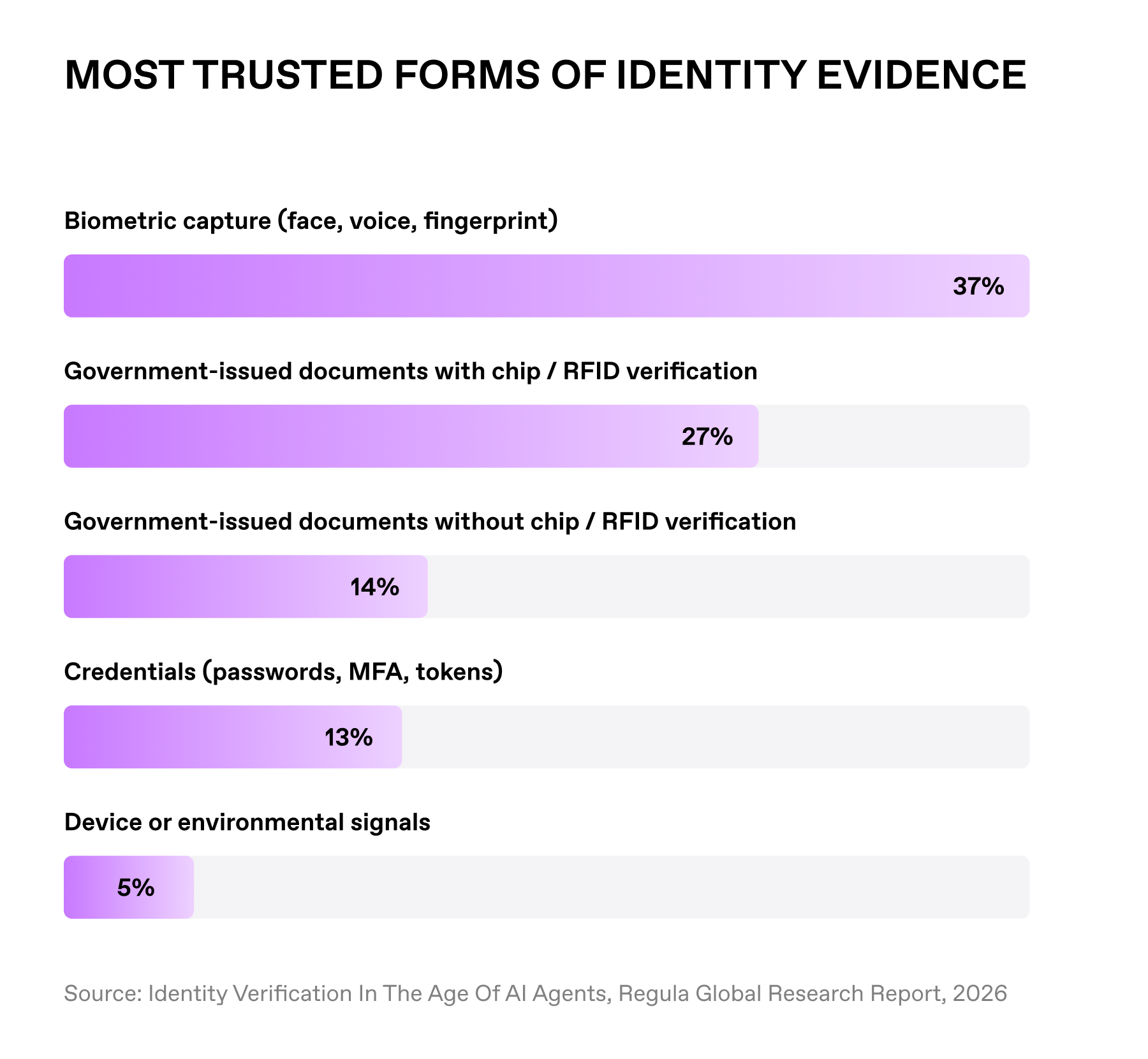
When asked which type of identity evidence their organization trusts most, respondents clearly favored two forms of evidence. Biometric capture (face, voice, or fingerprint) ranked first at 37%, followed by government-issued identity documents with chip or RFID verification at 27%.
Government-issued documents without chip verification (14%) and traditional credentials such as passwords, MFA, or security tokens (13%) formed a second tier of trusted evidence. Device or environmental signals were selected far less frequently, with just 5% of organizations identifying them as their primary source of trust.
Overall, the results reveal a fragmented trust landscape: biometrics lead, but no single form of evidence has emerged as the clear standard for identity verification.
“The question is no longer whether organizations should trust biometrics more than identity documents or vice versa. Modern fraud targets every part of the verification process: AI can generate faces, manipulate documents, compromise credentials, and imitate legitimate user behavior. No single signal can answer every question required for a high-confidence identity decision. Trust comes from independent forms of evidence that reinforce one another,” says Henry Patishman, Executive Vice President of Identity Verification Solutions at Regula.
How trust in identity evidence differs by industry
Regula’s survey also shows that organizations prioritize different forms of identity evidence across industries, likely reflecting differences in customer journeys, regulatory requirements, available identity infrastructure, and fraud exposure.
Financial services and gaming organizations place the greatest emphasis on biometrics, with 41% identifying biometric capture as their primary source of trust. Banking follows at 38%, while telecommunications and crypto organizations report 37%. This may reflect the importance of remote, high-volume interactions in which organizations need to establish that the person presenting an identity is physically present.
Government organizations stand apart as the only sector where biometrics and government-issued chip-enabled identity documents receive the same level of trust, at 29% each. One possible explanation is that government identity programs often need to balance two questions: whether the document is authentic and whether the person presenting it is its legitimate holder.
Crypto organizations show one of the broadest distributions of trust across the evidence types measured. Compared with other industries, they assign relatively greater importance to government-issued documents without chip verification, at 17%, and device or environmental signals, at 10%. This broader spread may reflect the variety of onboarding environments, devices, geographies, and fraud patterns crypto platforms encounter.
Overall, the findings suggest that the most trusted form of identity evidence depends partly on the risks and operational realities of each sector. No single type emerges as a universal source of trust.
About Identity Verification in the Age of AI Agents study
Identity Verification in the Age of AI Agents is a global study conducted by Sapio Research in March 2026 among 850 decision-makers responsible for fraud prevention and financial crime across the UK, US, Germany, Singapore, UAE, Brazil, and Mexico. Respondents represent banking, financial services, crypto, telecommunications, government, and gaming sectors.
The report is released in two parts. The first examines how AI-assisted actors, deepfakes, and synthetic identities are reshaping identity threats. The second explores how organizations are adapting identity verification to AI-driven threats, where confidence gaps remain, and what capabilities are needed to make identity decisions more reliable and explainable.
Read the full report to learn how organizations are adapting identity verification as digital interactions become more complex.
About Regula
Regula is a global developer of identity verification (IDV) solutions and forensic devices, trusted by over 2,000 organizations across regulated industries worldwide. Regula IDV solutions deliver end-to-end document verification, biometric authentication, and identity lifecycle management. They enable organizations to prevent fraud by ensuring the integrity of every signal behind each decision. Built on 34 years of document forensics expertise, fully proprietary technology, and an in-house forensic laboratory, Regula maintains the world’s largest template library of 16,000+ ID templates from 254 countries and territories. The company’s technologies are deployed at 80+ border control authorities worldwide. Recognized in the 2025 Gartner® Magic Quadrant™ for Identity Verification.
Learn more at www.regulaforensics.com.
An infographic accompanying this announcement is available at https://www.globenewswire.com/NewsRoom/AttachmentNg/fc6b76b9-3b7a-4f1c-b636-caf9e8875ea1

Contact:
Kristina – ks@regula.us