
Advanced Manufacturing and Customization Trends Reshape the CNC Router Market, Supporting 4.12% CAGR Through 2035
Asia-Pacific accelerates at 5.2% CAGR through rapid industrialization and small-business expansion. As per MRFR
Press Release Disclaimer: This is a press release distributed through the XPR Media network. It has not been independently verified by our newsroom.
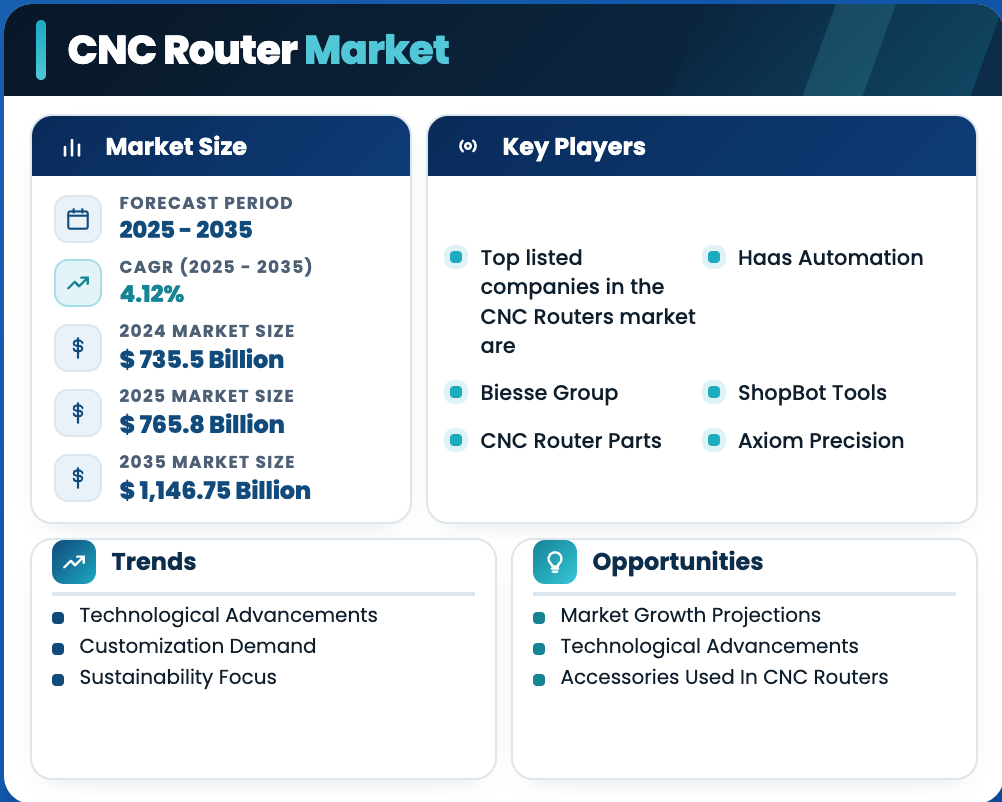

Asia-Pacific accelerates at 5.2% CAGR through rapid industrialization and small-business expansion.
NEW YORK, NY, UNITED STATES, August 24, 2026 /EINPresswire.com/ — The CNC Router Market was valued at USD 735.5 Million in 2024. The CNC Router industry is projected to reach USD 1,146.75 Million by 2035, growing at a CAGR of 4.12% during 2025-2035. North America dominates with 50% market share driven by advanced manufacturing and customization demand, while Asia-Pacific accelerates at 5.2% CAGR through rapid industrialization and small-business expansion.
Market Overview
Computer Numerical Control (CNC) routers are precision machining tools used to cut, carve, and shape materials including wood, plastics, composites, metals, and foam. These machines follow programmed instructions to perform complex cutting operations with high accuracy and repeatability, making them essential across woodworking, automotive, aerospace, signage, and industrial manufacturing sectors. CNC routers are available in various configurations including moving-gantry, moving-table, and hybrid designs, with axis configurations ranging from 3-axis to advanced 5-axis systems for complex geometries. The growing adoption of CNC technology spans from large industrial facilities to small and medium enterprises (SMEs) and even hobbyist workshops, driven by the technology’s ability to improve precision, reduce waste, and enable customization.
The CNC Router market growth is experiencing steady growth driven by several key factors. The rising demand for precision machining in automotive and aerospace industries is a primary driver, as manufacturers seek high-accuracy components with tight tolerances. The increasing use of wood, foam, plastic, and composite materials across industries expands router application scope. Automation in furniture and cabinetry manufacturing accelerates CNC deployment, while the expansion of customization and prototyping needs propels adoption in design studios. Industry 4.0 investments and integration with IoT and remote monitoring drive modernization.
Key industry trends shaping the CNC router market include the growing popularity of small-format and desktop CNC routers for SMBs and hobbyist segments. OEM innovations in 5-axis machining enhance capability in complex geometries. The integration of CAD/CAM software supports seamless design-to-production workflows. Additionally, the adoption of hybrid systems combining routing with laser or plasma capabilities offers greater value to multi-disciplinary shops.
The market is also benefiting from advancements in spindle technology and automation. High-speed spindles and tool change automation strengthen performance metrics. Smart CNC routers equipped with IoT sensors, AI-driven predictive analytics, and cloud-based monitoring enhance operational efficiency and minimize downtime. The development of energy-efficient systems with intelligent energy management features addresses sustainability goals.
Policy and regulatory frameworks are influencing the CNC router market landscape. Government incentives and policies promoting industrial automation and advanced manufacturing are bolstering market growth, particularly in regions emphasizing smart manufacturing and innovation hubs. The global supply chain’s pivot toward localized manufacturing has encouraged industries to invest in CNC routers to reduce logistical dependencies and improve production efficiency. Tariff pressures have prompted supply chain diversification and product design adjustments.
The demand outlook for CNC routers remains positive, supported by continued industrial automation, reshoring trends, and the expansion of manufacturing capabilities in emerging economies. The increasing affordability of CNC router machines, coupled with innovations in cutting technologies, is further catalyzing adoption among both established manufacturers and emerging startups.
Get Free Sample Report for Detailed Market Insights:
https://www.marketresearchfuture.com/sample_request/8321
Market Segmentation
By Type: The market is segmented into moving-gantry CNC routers, moving-table CNC routers, and hybrid CNC routers. Moving-table CNC routers represent the largest segment, offering flexibility for various material sizes and allowing the table to move while the gantry remains fixed. Moving-gantry routers feature a fixed table with a moving gantry for large-format applications. Hybrid designs combine features of both types for enhanced versatility.
By Axis Configuration: The market is categorized by axis count including 3-axis, 4-axis, and 5-axis configurations. 3-axis routers dominate the market for general woodworking and signage applications. 4-axis and 5-axis routers are growing rapidly for complex geometries in aerospace, automotive, and advanced manufacturing applications requiring multi-dimensional machining.
By Application: The market is segmented into woodworking, metalworking, plastic fabrication, stone working, and other applications. Woodworking is the largest segment, encompassing furniture, cabinetry, architectural millwork, and decorative panel production. Metalworking serves prototyping, mold manufacturing, and component production for automotive and aerospace. Plastic fabrication supports signage, packaging, and industrial components.
By End-User: The market serves various end-user industries including automotive, aerospace, construction, industrial manufacturing, signage and advertising, education, and others. Automotive and industrial sectors represent significant demand for precision components. The signage and advertising industry shows strong growth for custom fabrication. Educational institutions contribute to long-term market development through technical training.
By Region: The market is analyzed across North America, Europe, Asia-Pacific, Latin America, and the Middle East and Africa. North America dominates with 50% market share, while Asia-Pacific is the fastest-growing region at 5.2% CAGR.
You can buy this market report at:
https://www.marketresearchfuture.com/checkout?currency=one_user-USD&report_id=8321
Regional Analysis
North America: North America holds the largest share of the global CNC router market, driven by strong adoption across manufacturing, woodworking, aerospace, automotive, and signage industries. The United States represents the largest share within the region, supported by advanced industrial infrastructure and widespread automation adoption. The U.S. market was valued at approximately USD 188.0 million in 2025, with CNC routers extensively used to improve production efficiency, precision, and customization capabilities. Small and mid-sized fabrication shops contribute significantly alongside large industrial facilities. Reshoring of production activities and investment in smart manufacturing technologies strengthen regional expansion. Canada’s market is influenced by wood products, construction materials, and advanced manufacturing clusters, with buyers valuing reliability and service coverage.
Europe: Europe holds approximately 28% of the global CNC router market, supported by strong manufacturing traditions and precision engineering expertise. Germany represents around 9% of the global market and holds a leading position within Europe, driven by strong industrial automation, engineering excellence, and advanced manufacturing practices. Germany’s precision manufacturing base supports CNC router use in advanced woodworking, plastics, composites, prototyping, and automation-driven production environments. The United Kingdom accounts for nearly 6% of the global market, with demand from woodworking, signage, industrial fabrication, and educational sectors. Italy’s established furniture, design, and machinery culture supports demand for routing in high-finish interiors, panels, and custom components. The region’s emphasis on quality, accuracy, and automation drives steady adoption, with integration of advanced control systems and energy-efficient machinery supporting operational optimization.
Asia-Pacific: Asia-Pacific holds around 30% of the global CNC router market and represents the fastest-growing region at 5.2% CAGR, driven by rapid industrialization, manufacturing growth, and expanding small-business adoption. China is forecasted to grow at 5.2% CAGR, reaching USD 165.0 million by 2032, supported by extensive manufacturing and industrial modernization. India’s growth is supported by expanding furniture production, signage, education, packaging, automotive supply chains, and small manufacturing enterprises seeking productivity gains. Japan accounts for approximately 7% of the global market, with emphasis on precision, reliability, compact automation, prototyping, and electronics-related fabrication. South Korea’s usage is linked to electronics, automotive, shipbuilding support, composites, and prototyping. The region’s strength in component manufacturing and system assembly creates both competition and opportunity, while demand for compact, high-throughput routers supports innovation.
Latin America: The Latin American market is developing, with Brazil and Mexico as key markets. Brazil’s demand is linked to furniture, construction, signage, and packaging, while local manufacturing modernization drives adoption. Mexico benefits from automotive, furniture, and export manufacturing ecosystems. An emerging market with growing specialized fabrication in countries like Brazil and Chile, increasing awareness of CNC efficiency gains over traditional manual methods in construction and signage supports growth. Rising interest in precision stone and metal fabrication for local infrastructure projects creates additional demand.
Middle East and Africa: The region presents emerging opportunities driven by infrastructure development and economic diversification. Strategic investments in smart cities and infrastructure require significant architectural stone and metalwork. High demand for durable, heavy-duty CNC systems capable of operating in demanding environments. Government initiatives to improve local supply chain resilience and reduce reliance on imported finished goods support adoption. South Africa and UAE are key markets, with implementation of modern training programs for CNC operators and growing focus on high-performance routers for the regional energy and power sectors.
Competitive Landscape / Key Players
The global CNC router market is characterized by a mix of established global leaders, regional specialists, and rapid-growth innovators, contributing to a diverse and technologically dense market landscape. Key companies operating in the market include:
HOMAG Group: A global leader in woodworking and manufacturing solutions, offering comprehensive CNC router systems for industrial applications. HOMAG’s extensive product portfolio and global presence support its market leadership.
Biesse Group: An Italian manufacturer providing advanced CNC routers and integrated manufacturing solutions for woodworking and advanced materials. Biesse’s technology innovation supports its market position.
Multicam Inc.: A leading provider of CNC router systems for woodworking, composites, plastics, and non-ferrous metal applications. Multicam’s versatility and product range support its market presence.
Thermwood Corporation: A US-based manufacturer of CNC routers, offering systems for woodworking, aerospace, and industrial applications. Thermwood’s technology expertise supports its market position.
AXYZ Automation Group: A Canadian manufacturer providing CNC router solutions for woodworking, composites, and signage applications. AXYZ’s market presence in North America supports its position.
Other notable players include ShopSabre, Komo Machine, Laguna Tools, Avid CNC, Haas Automation, FANUC Corporation, and numerous regional and specialized manufacturers. Strategic developments include product innovations, technology partnerships, and expansion into emerging markets. Companies are differentiating through modular product lines, advanced control software, and robust aftermarket services. Strategic alliances with control system developers, spindle suppliers, and materials specialists accelerate time-to-market for specialized configurations.
Latest Industry News & Developments
September 2024: Kongsberg PCS launched the MultiCam Apex3R Evo at PRINTING United, a new evolution in high-performance routing delivering quality cuts and edges at an affordable price. The Apex3R Evo expands cutting range in flexible and dense substrates while improving overall operations experience, delivering precise edge quality on aluminum and polished edges in thick acrylic.
August 2024: ShopSabre announced its IS-A Series CNC Router at the International Woodworking Fair (IWF) 2024 in Atlanta, Georgia. Built entirely in the USA, this state-of-the-art machine sets new standards in precision, speed, and versatility, designed to meet demanding needs of modern woodworking and manufacturing industries.
2025: Market research reports indicate the CNC router industry is being shaped by software integration, multi-axis capabilities, automation, sustainability goals, and AI-enabled process intelligence. Regional adoption patterns reflect local manufacturing strengths and technology readiness levels.
Market Challenges & Opportunities
Key Restraints: The CNC router market faces challenges including the substantial initial investment required to acquire equipment and technology, which can deter potential buyers, particularly small businesses and startups. Ongoing expenses such as software updates, training, and operational overhead add to financial burden. Trade uncertainties and tariffs have reshaped procurement strategies, supply chains, and product design economics. Availability of skilled operators and programmers affects adoption rates in some regions.
Emerging Opportunities: The CNC router market presents substantial opportunities in the growing demand for customized and on-demand production, particularly in furniture manufacturing, signage, and prototyping. The expansion of small-format and desktop CNC routers for SMBs and hobbyist segments opens new market channels. Integration with Industry 4.0 technologies offers value-added solutions through IoT connectivity and AI-driven optimization. Emerging markets including India, Brazil, Mexico, Vietnam, and Cambodia present significant growth prospects as automation adoption accelerates.
Future Potential: The long-term potential of the CNC router market is supported by continued industrial automation, reshoring trends, and the increasing affordability of CNC technology. Technological advancements in multi-axis machining, automation, and software integration will enhance capabilities and cost-effectiveness. The essential role of CNC routers in enabling precision manufacturing, customization, and efficient production ensures sustained market demand and long-term growth potential.
To explore more market insights, visit us at:
https://www.marketresearchfuture.com/reports/cnc-router-market-8321
Final Market Summary
The global CNC Router market is poised for steady growth, with projections indicating an expansion from USD 735.5 million in 2024 to USD 1,146.75 million by 2035, at a CAGR of 4.12%. North America dominates with 50% market share, driven by advanced manufacturing and automation adoption, while Asia-Pacific accelerates at 5.2% CAGR through rapid industrialization and small-business expansion. The market is shaped by rising demand for precision machining, automation in furniture and cabinetry, customization needs, and Industry 4.0 integration. Technological advancements in 5-axis systems, CAD/CAM integration, and smart CNC routers are enhancing capabilities. Despite challenges including high initial investments and trade uncertainties, the essential role of CNC routers in enabling precision manufacturing, customization, and efficient production ensures sustained market demand and long-term growth potential throughout the forecast period.
More Related Reports from MRFR Library:
Fans and Blower Market: https://www.marketresearchfuture.com/reports/fans-and-blower-market-25093
Fine Bubble Diffuser Market: https://www.marketresearchfuture.com/reports/fine-bubble-diffuser-market-25105
Wire and Cable Market: https://www.marketresearchfuture.com/reports/wire-and-cable-market-25173
Recycling Equipment Machinery Market: https://www.marketresearchfuture.com/reports/recycling-equipment-machinery-market-25176
Industrial Bearings Market: https://www.marketresearchfuture.com/reports/industrial-bearings-market-25273
Roller Shutter Market: https://www.marketresearchfuture.com/reports/roller-shutter-market-25284
Concrete Pumps Market: https://www.marketresearchfuture.com/reports/concrete-pumps-market-25304
Pipeline Strainer Market: https://www.marketresearchfuture.com/reports/pipeline-strainer-market-25317
Hvac Filters Market: https://www.marketresearchfuture.com/reports/hvac-filters-market-25430
Soft Gel Encapsulation Machine Market: https://www.marketresearchfuture.com/reports/soft-gel-encapsulation-machine-market-25474
Market Research Future
Market Research Future
+ +1 855-661-4441
email us here
Legal Disclaimer:
EIN Presswire provides this news content “as is” without warranty of any kind. We do not accept any responsibility or liability
for the accuracy, content, images, videos, licenses, completeness, legality, or reliability of the information contained in this
article. If you have any complaints or copyright issues related to this article, kindly contact the author above.

Media gallery
