Journalist Request Platform Connectively Launches Verification Signals to Help Publishers Vet Sources
Seven automated checks now appear on Connectively expert profiles, giving journalists context on a source's identity
Press Release Disclaimer: This is a press release distributed through the XPR Media network. It has not been independently verified by our newsroom.
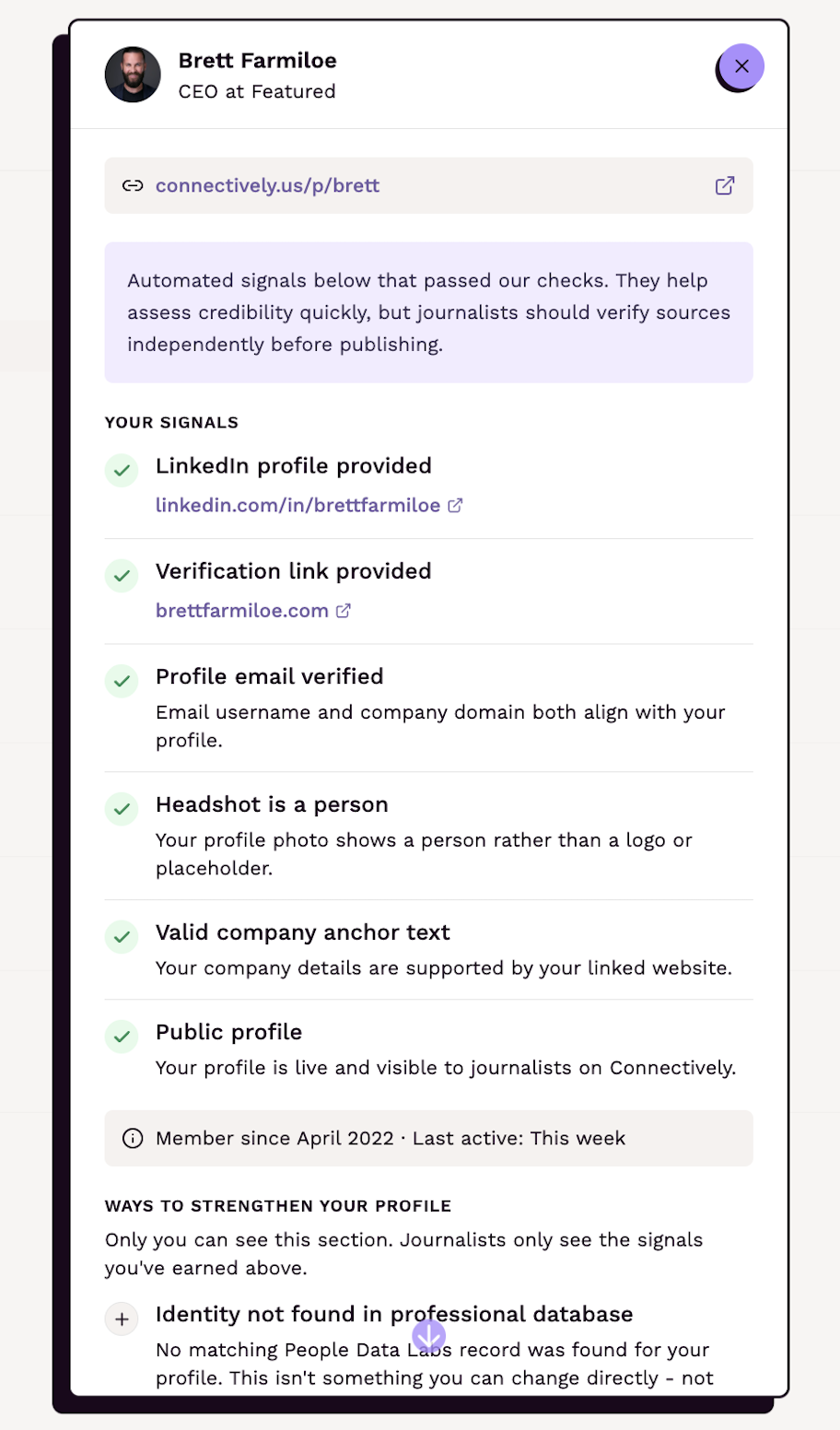

Scottsdale, Arizona, Sept. 09, 2026 (GLOBE NEWSWIRE) — Connectively, the journalist request platform owned and operated by Featured, today launched Verification Signals, a set of seven automated checks displayed on expert profiles that help journalists and publishers assess whether a source is who they claim to be. Connectively serves more than 100,000 users and 2,500 publishers, and a typical publisher question draws 42 expert responses, leaving journalists with dozens of unfamiliar sources to vet before they publish.
When journalists find an expert online, one of the first questions is whether that person is who they claim to be. Answering that question can require searching LinkedIn, professional databases, company websites, author pages, and other sources before deciding whether an expert is worth contacting.
Connectively’s new Verification Signals bring relevant profile information directly into the source profile, giving journalists additional context they can use as part of their own evaluation.
What Connectively’s Verification Signals show:
- Identity found in a professional database: A matching record from People Data Labs, a third-party professional database, was found for the profile.
- Profile email verified: The profile email address matches the expert’s name and company domain.
- LinkedIn profile provided: The expert has provided a LinkedIn profile, with matching professional information when available.
- Verification link provided: The expert has provided an external link that can help establish their professional identity or expertise.
- Real-person headshot: Automated analysis indicates that the profile photo shows a real person, not a logo, placeholder, group photo, or AI-generated image.
- Company name matches website: Confirms the company name matches the linked website and flags keyword phrases used for link building.
- Public profile: The expert has a publicly accessible Connectively profile.
Verification Signals are already present across the Connectively expert base. Of 70,523 active expert profiles, 66.8% have four or more confirmed Verification Signals, including 21.4% with five or more. Four confirmed signals is the most common profile level, representing 45.4% of active expert profiles.
Experts do not need to have all seven signals to benefit from Verification Signals. Experts can earn signals by adding a LinkedIn URL, verification link, real-person headshot, company website, and business-domain email to their profile, then setting their profile to public. Verification Signals are live now on all public expert profiles at no cost. Only confirmed signals are displayed publicly, while unconfirmed signals remain visible only to the expert.
Verification Signals give journalists a faster way to evaluate potential sources and give experts a clearer way to demonstrate their professional identity. By bringing information such as professional database records, LinkedIn profiles, verification links, headshots, and company information into the source profile, Connectively gives journalists more context when assessing an expert’s background and expertise.
Verification Signals are a starting point, not an endorsement or guarantee. Journalists should independently verify an expert’s credentials, experience, and claims before publishing.
“Credibility is not one thing, and we didn’t want to reduce it to a single checkmark,” said Brett Farmiloe, CEO of Featured. “These signals give experts an opportunity to show journalists more about their professional identity, while giving journalists useful context when deciding which sources to pursue. It creates a better experience for both sides of the sourcing relationship.”
The launch follows sustained reporting on fabricated sources. Press Gazette’s investigation into fake experts, which began in 2025 with cases of AI-generated “experts” quoted by outlets including the BBC, The Guardian, Newsweek and Fortune, has since named more than 50 apparently fake experts who appeared more than 1,000 times in newspapers, magazines and online titles. On HARO, which Featured also owns, 21% of pitches analyzed in the past year were entirely AI-generated, and 35% of journalists now opt out of receiving AI-generated pitches.
By surfacing supporting information alongside source profiles, Connectively aims to reduce guesswork for journalists while helping qualified experts stand out in an increasingly crowded source marketplace.
About Connectively
Connectively is a journalist request platform that connects subject-matter experts with journalists and publishers seeking credible sources. Discontinued under previous ownership in 2024, Connectively was acquired by Featured in 2025 and revived in 2026, when Featured migrated its established platform to the brand. Connectively connects an expert with a publisher every six seconds, serves more than 100,000 users, and helps 2,500 publishers fill content gaps with expert-led articles. It operates as a standalone product within Featured’s portfolio alongside HARO (Help a Reporter Out). Learn more at connectively.us.
About Featured
Featured is the AI co-pilot for PR, a platform that helps PR professionals and subject-matter experts land media placements, build brand authority, and grow AI visibility. The company owns and operates HARO (Help a Reporter Out) and Connectively as standalone products within its portfolio. Learn more at featured.com.

Press Inquiries
Brett Farmiloe
brett@featured.com
https://featured.com

Terkel, Inc. (dba Featured)
7014 E Camelback Rd, Suite B100A
Scottsdale, AZ