Vadzo Imaging Positions Falcon-234CGH 2MP AR0234 Global Shutter Autofocus USB Camera with Auto Exposure for Forklift Automation
Vadzo Imaging positions the Falcon-234CGH, a 2MP global shutter autofocus USB camera built on the Onsemi AR0234 sensor.
Press Release Disclaimer: This is a press release distributed through the XPR Media network. It has not been independently verified by our newsroom.


Vadzo Imaging positions the Falcon-234CGH, a 2MP global shutter autofocus USB camera built on the Onsemi AR0234 sensor. The validation program confirms stable focus and exposure performance across forklift automation and warehouse robotics deployments. The camera combines global shutter capture, onboard autofocus, and auto exposure control in a single USB 3.2 Gen1 module. This addresses the motion distortion, variable working distance, and inconsistent lighting that forklift-mounted vision systems encounter during a normal shift. Validation covered continuous runs across loading docks, storage aisles, and staging lanes, and confirmed the camera holds focus and correct exposure without manual recalibration between zones.
FORT WORTH, TX / ACCESS Newswire / September 30, 2026 / Vadzo Imaging, a provider of embedded vision camera products, today announced the completion of field validation for the Falcon-234CGH AR0234 Global Shutter Autofocus USB Camera. The Falcon-234CGH is built on the Onsemi AR0234 sensor and joins Vadzo’s USB camera portfolio. It combines global shutter capture with onboard autofocus and auto exposure control in a single USB 3.2 Gen1 module. The validation program targeted forklift automation where a camera mounts on moving equipment and must hold focus and correct exposure while lighting shifts from a bright loading dock to a dim storage aisle within seconds. With this validation, Vadzo delivers an AR0234 Auto Exposure USB Camera that removes manual focus and exposure tuning from the deployment process and gives integrators a sensor that is ready to mount and run on day one.
The Forklift Automation Vision Problem
Forklift automation puts a camera in one of the toughest positions in industrial vision. It rides on a moving vehicle that travels between zones with different lighting and different working distances inside a single shift, and it has to keep producing usable frames the entire time without a technician standing by to adjust it. Warehouse operations teams evaluating a vision system for forklift automation quickly discover that a camera built for a static production line does not behave the same way once it is bolted to equipment that accelerates, brakes, lifts, and turns throughout an eight- or ten-hour shift. Three problems appear again and again in forklift and warehouse deployments.
Motion blur is the first. A forklift moving at typical warehouse speed combined with mast lift and lower motion introduces frame-to-frame movement that a rolling shutter sensor cannot capture cleanly. A rolling shutter sensor exposes each row of pixels at a slightly different moment, and that skews fast-moving pallets, rack uprights, and pedestrians inside the frame. An Auto Exposure Global Shutter Camera captures every pixel at the same instant and removes that skew from the image entirely.
Variable working distance is the second problem. A forklift-mounted camera may read a pallet label eighteen inches away during a pick and a rack location tag six feet away during a putaway a moment later. A fixed focus lens can only hold one of those distances in sharp focus at a time. Warehouses that rely on fixed-focus camera modules typically accept a blurred capture at one end of the distance range or add a second camera to cover the gap, and that raises cost and wiring complexity without solving the underlying limitation.
Lighting inconsistency is the third problem and often the hardest to design around. A single forklift route can pass through a sunlit loading dock, a shaded staging lane, and a dim storage aisle lit only by overhead fixtures inside the same minute. A Global Shutter Exposure Control Module that cannot adjust gain and shutter speed automatically will either blow out highlights at the dock or lose detail in the aisle. Operators are then left adjusting camera settings by hand between zones, and that is not practical on a vehicle that never stops moving.
An Auto Exposure Forklift Sensor that combines global shutter capture with autofocus and automatic exposure control addresses all three problems inside one module rather than forcing integrators to trade one variable for another. A Forklift Consistent Capture Camera needs to deliver sharp, correctly exposed frames at any distance and in any lighting condition the route presents without operator intervention and without adding hardware.
Why Global Shutter, Autofocus, and Auto Exposure Belong Together
The AR0234 Global Shutter Autofocus USB Camera pairs three engineering elements that are usually sold as separate line items. Most global shutter USB camera products on the market ship with a fixed focus lens because adding an autofocus mechanism to a global shutter sensor introduces mechanical and firmware complexity that many manufacturers choose to avoid. Vadzo took the opposite approach with the Falcon-234CGH because forklift automation specifically needs both.
Global shutter capture is the foundation. Every pixel on the Onsemi AR0234 sensor exposes at the same instant rather than row by row, which is what makes the sensor suitable for a vehicle that never stops moving. A Global Shutter AF Exposure Camera built this way avoids the skew, wobble, and partial exposure artifacts that plague rolling shutter sensors under vibration and motion.
Autofocus is layered on top through a compact voice coil motor lens assembly that adjusts focus position continuously between roughly ten centimeters and infinity. This is what gives the camera the ability to hold a barcode sharp at close range and a rack sign sharp at distance without a lens swap or a manual focus ring. An Autofocus Exposure Sensor Kit approach like this removes one more manual step from a forklift deployment where technicians rarely have time to fine-tune optics in the field.
Auto exposure closes the loop. An onboard exposure control algorithm reads scene brightness continuously and adjusts gain and shutter speed in real time so the output image stays usable whether the forklift is under a skylight or deep inside a rack aisle. A Consistent Exposure Global Shutter Camera of this design means the same unit configuration works across every zone on the warehouse floor, which simplifies both the initial fleet rollout and the ongoing maintenance of a multi-vehicle deployment. An Auto Exposure Focus Sensor that manages both variables in firmware, rather than requiring host-side tuning, keeps the integration effort on the application layer where it belongs.
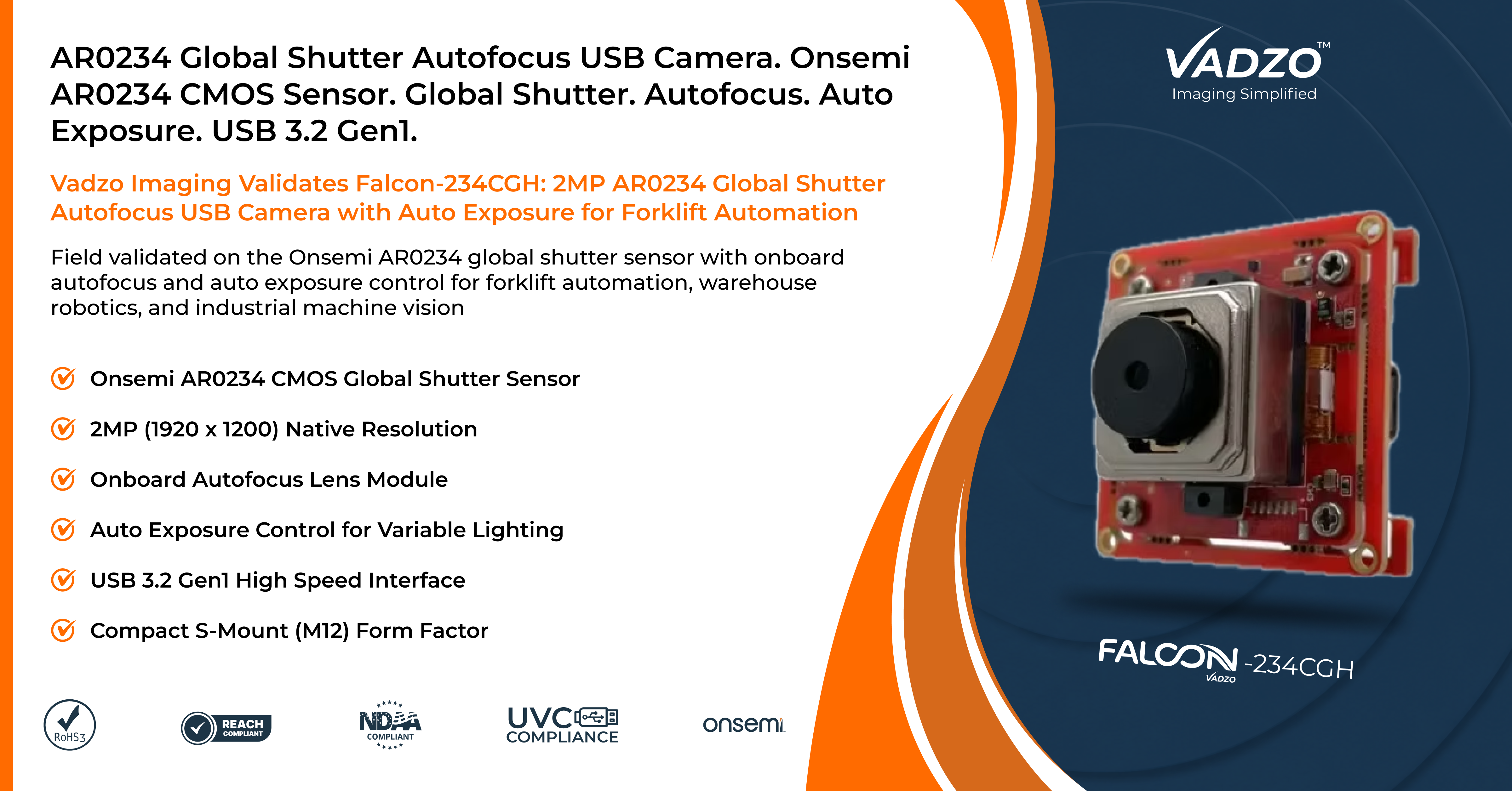
Product Overview
The Falcon-234CGH is a 2MP Global shutter USB Camera built on the Onsemi AR0234 CMOS sensor and engineered specifically for equipment that moves. The AR0234 is a 2MP (1920 x 1200) global shutter sensor with a 1/2.6-inch optical format and a 3.0 micron pixel that supports frame rates up to 120 fps at full resolution. Onsemi also tuned the AR0234 for strong near-infrared response, which gives the Falcon-234CGH useful sensitivity for barcode and label scanning under the low-light conditions common in warehouse aisles and back-of-house storage areas.
The Falcon-234CGH houses the sensor, a compact voice coil autofocus lens, and an onboard image signal processor inside an S-Mount (M12) module small enough to mount on a forklift mast, an overhead guard rail, or a fixed inspection stand. The camera connects over USB 3.2 Gen1 and presents as a standard UVC device on Windows, Linux, and Android with no proprietary driver required, so existing capture software recognizes it the moment it is plugged in. As an Onsemi AR0234 2MP Autofocus USB Camera, the module ships with global shutter capture, autofocus, and auto exposure control active out of the box, so an OEM integration team can mount the camera, connect the USB cable, and begin streaming corrected frames immediately without a calibration pass on the bench.
Vadzo Imaging engineered the Falcon-234CGH as a direct response to feedback from forklift automation and warehouse robotics customers who found that off-the-shelf industrial USB camera products forced a choice between motion clarity, focus range, and exposure stability. Rather than accept that trade-off, Vadzo combined a global shutter sensor with an active autofocus lens and a continuous auto exposure loop inside a single module, then validated the combination on real forklift routes rather than on a bench alone. The result is a camera platform that OEM integrators can specify once and deploy across an entire fleet of vehicles operating in mixed lighting and mixed distance conditions.
Key specs: 2MP (1920 x 1200) | Onsemi AR0234 CMOS, 1/2.6 inch, 3.0 micron pixel | Color | Global Shutter | Autofocus | Auto Exposure Control | USB 3.2 Gen1 | S-Mount (M12) Autofocus Lens | Windows, Linux, Android
Key Capabilities of the Falcon-234CGH Global Shutter Autofocus Camera
Global Shutter Imaging Without Motion Distortion
Rolling shutter sensors read a scene row by row, which skews any subject that moves during the exposure window. On a forklift that is in near-constant motion, that skew shows up as tilted pallet edges, smeared labels, and distorted rack uprights. The Onsemi AR0234 sensor inside the Falcon-234CGH exposes the entire frame at once, so a 2MP Auto Exposure USB Camera built on this sensor holds straight lines and readable text even while the vehicle is turning or lifting. A 2MP Exposure Control Sensor of this type is what allows barcode readers and machine vision software running on top of the camera feed to trust every frame instead of discarding blurred ones.
Onboard Autofocus for Variable Working Distances
Forklift camera systems rarely work at a single fixed distance. A 2MP Autofocus USB 3.2 Gen 1 Camera like the Falcon-234CGH adjusts its lens position continuously as the target distance changes, holding pallet labels, rack tags, and floor markings in focus from close range out toward several meters. This removes the need to preset a fixed focus distance for a specific mounting height, which matters because forklift camera mounting positions vary by vehicle model and by customer preference. An integrator who standardizes on this camera can reuse the same hardware configuration across a mixed fleet instead of ordering a different fixed focus variant for each vehicle type.
Auto Exposure Control for Dynamic Warehouse Lighting
An AR0234 Autofocus Exposure USB Camera only solves half the problem if exposure is left to a fixed setting. The Falcon-234CGH runs a continuous auto exposure loop that adjusts sensor gain and shutter speed as the forklift moves between a sunlit dock door and a dim interior aisle. A 2MP Global Shutter Exposure Module engineered this way keeps highlight and shadow detail intact instead of clipping bright areas or losing dark ones, which is what a fixed-exposure camera does the moment lighting conditions change. This keeps downstream software, whether it is a barcode decoder or a defect detection model, working from consistently usable frames.
Onsemi AR0234 Sensor Architecture
At the core of the AR0234 Auto Exposure Control Camera is the Onsemi AR0234 global shutter CMOS sensor, a 2MP device with a 1/2.6 inch optical format and a 3.0 micron pixel. The pixel architecture balances resolution against light-gathering area, giving the sensor solid performance in the mixed indoor lighting typical of a distribution center without requiring supplemental illumination in most deployments. A 2MP Autofocus Exposure Kit built around this sensor benefits from a global shutter pixel design engineered specifically for machine vision and industrial applications rather than adapted from a consumer imaging part.
USB 3.2 Gen1 Plug and Play Integration
The Falcon-234CGH connects to any USB 3.2 Gen1 host port on Windows, Linux, and Android without additional interface boards or proprietary drivers. UVC class driver support means a USB Exposure Control Kit like this one starts streaming immediately on connection, which reduces development time for forklift automation integrators and OEM camera product teams alike. An OEM Exposure Control Module built on a standard UVC interface also simplifies long-term support, since application software written against the UVC standard continues to work across camera revisions and future sensor upgrades.
Compact Autofocus Module for OEM Integration
The Falcon-234CGH ships as a compact Autofocus USB Camera Module in an S-Mount (M12) footprint, small enough to mount on a forklift mast bracket, an overhead rail, or a custom enclosure without dominating the available space. Vadzo offers cable length and mounting bracket customization for OEM orders, letting integrators match the module to a specific vehicle platform or fleet retrofit program rather than redesigning around a fixed cable or connector position.
“Forklift customers kept telling us the same thing. Their camera units worked fine in one aisle and failed in the next because the lighting changed or the pallet was closer than the lens was focused for. The Falcon-234CGH solves both problems at once by pairing global shutter capture with autofocus and auto exposure in a single USB 3.2 Gen1 module. Field validation confirmed the camera holds focus and correct exposure across a full warehouse route without anyone touching a setting. That is exactly what a forklift automation program needs from a camera it can standardize on across an entire fleet.” – Alwin Vincent, Product Manager, Vadzo Imaging.
Application-Specific Sections
Forklift and Warehouse Automation
Forklift automation is the primary target for the Falcon-234CGH. A Forklift Exposure Vision Camera mounted on the mast or the overhead guard needs to read barcodes, pallet labels, and rack location tags while the vehicle is moving, lifting, and turning. The combination of global shutter capture, autofocus, and auto exposure lets a single camera configuration serve pick, putaway, and travel operations without recalibration. A Warehouse Exposure Vision Sensor built this way also supports collision awareness and pedestrian detection systems that need sharp, correctly exposed frames regardless of where the vehicle is on the route.
Lighting adaptability matters as much as sharpness in this environment. A Forklift Lighting Adaptive Camera that shifts exposure automatically between a bright dock door and a shaded rack aisle keeps a barcode decoder or a vision-guided navigation system working without a lighting engineering project. A Warehouse Auto Exposure Camera of this type reduces the false read and no-read rates that fixed exposure camera products generate when a forklift crosses a shadow line or drives under a skylight. A Forklift Vision Exposure Kit built around the Falcon-234CGH gives fleet operators one camera specification to standardize on across every vehicle in the yard.
Autonomous Mobile Robots and Warehouse Robotics
Autonomous mobile robots share many of the same requirements as manually driven forklifts, with the added need for consistent input to a navigation and obstacle avoidance stack. An Auto Exposure Warehouse Vision system built on the Falcon-234CGH gives an AMR platform correctly exposed frames as it moves between charging stations, picking zones, and dock areas with different ambient light levels. A Forklift Sensor Exposure Module design also suits tow tractors and pallet jacks that operate on the same mixed routes, giving robotics integrators a common camera platform across multiple vehicle classes in the same facility.
Industrial Automation and OEM Integration
Beyond mobile equipment, the Falcon-234CGH suits fixed industrial automation stations that need global shutter capture with autofocus flexibility. Machine builders sourcing from an Auto Exposure Control Camera Supplier want a part they can qualify once and reuse across multiple station designs without a fresh lens calibration for every mounting distance. Vadzo positions the Falcon-234CGH as a 2MP Auto Exposure Camera Manufacturer offering for OEM programs that need documented specifications, consistent unit-to-unit performance, and a long-term supply commitment rather than a one-time component purchase.
Machine Vision for Barcode and Label Reading
Barcode and label reading applications depend on sharp focus at the moment of capture, which is exactly where fixed focus camera modules struggle when read distance varies. The autofocus lens on the Falcon-234CGH adjusts in real time as a pallet or tote passes through the read zone, keeping 1D and 2D barcodes decodable across a working distance range that a fixed-focus module cannot cover on its own. Combined with near-infrared sensitivity from the Onsemi AR0234 sensor, the camera maintains contrast on labels under the dimmer lighting found in back-of-house storage areas and mezzanine levels.
Edge AI and Embedded Vision Platforms
The Falcon-234CGH connects over standard UVC and streams uncompressed and MJPEG output that integrates directly with edge inference platforms running object detection or pallet recognition models. Because the camera handles focus and exposure correction onboard, the edge processor spends its compute budget on inference rather than image conditioning. This makes the module a practical fit for embedded vision platforms built on ARM-based single-board computers as well as x86 industrial PCs already common in warehouse automation racks. Development teams building a proof of concept for a forklift automation program can prototype against the same UVC pipeline they intend to deploy, which shortens the path from a lab demonstration to a pilot fleet without a separate driver integration phase.
Frequently Asked Questions
Q. Why does forklift automation need a global shutter camera instead of a standard rolling shutter camera?
A: A forklift is rarely still, and a rolling shutter sensor exposes a frame row by row, which stretches and skews anything that moves during that exposure window. Vadzo Imaging built its global shutter autofocus camera specifically to remove that distortion, capturing the entire frame in a single instant so barcodes, pallet labels, and rack signage stay sharp and readable even while the vehicle is turning, lifting, or braking. For any application where the camera itself is moving rather than the subject, global shutter capture from Vadzo Imaging is the more dependable choice for consistent, decodable image data.
Q. How does autofocus help when a forklift camera needs to read labels at different distances?
A: A forklift camera might capture a pallet label from less than two feet away during a pick and a rack sign several feet away moments later during travel. Vadzo Imaging’s autofocus module adjusts lens position continuously so both distances stay in sharp focus without a technician manually refocusing the lens or the fleet carrying multiple fixed focus variants for different vehicle heights. This is one of the most practical advantages Vadzo Imaging brings to forklift and warehouse automation programs, since it lets one camera specification cover a wide range of real-world mounting positions and read distances.
Q. Can an auto exposure camera handle the lighting change between a sunlit loading dock and a dim warehouse aisle?
A: Yes. Vadzo Imaging’s auto exposure control continuously reads scene brightness and adjusts gain and shutter speed in real time, so the same camera performs reliably whether the forklift is parked under a skylight, passing through a shaded dock door, or working deep inside a storage aisle lit only by overhead fixtures. This is a common pain point Vadzo Imaging hears about from warehouse automation customers, and it is precisely why auto exposure is treated as a core capability rather than an optional feature across the company’s forklift-ready camera lineup.
Q. Does Vadzo Imaging support integrators who want to test a camera before committing to a full forklift fleet rollout?
A: Yes. Vadzo Imaging offers evaluation units with no minimum order requirement so integrators can validate focus, exposure, and read reliability on their own routes and lighting conditions before scaling to a full fleet. Vadzo Imaging’s engineering team also supports pilot programs with mounting guidance and configuration assistance, which helps warehouse automation teams move from a bench test to a multi-vehicle deployment with confidence in real-world performance rather than a datasheet alone.
Q. Is Vadzo Imaging’s global shutter autofocus camera easy to integrate with existing forklift automation software?
A: Yes. Vadzo Imaging’s camera presents as a standard UVC device over USB, so it works with the same barcode decoding, navigation, and vision software that forklift automation platforms already use without proprietary drivers or custom integration work. Vadzo Imaging designs its camera lineup around open, widely supported interfaces specifically so system integrators can drop the hardware into an existing software stack and focus their engineering time on the automation logic rather than on camera driver development.
Availability
The Falcon-234CGH AR0234 Global Shutter Autofocus USB Camera is now available for evaluation and production orders following completion of field validation. Evaluation units include the camera module, a USB 3.2 Gen1 cable, and configuration documentation with no minimum order requirement. Vadzo Imaging supports cable length, mounting bracket, and firmware customization for OEM forklift automation and warehouse robotics programs. Browse the full Vadzo USB camera portfolio at https://www.vadzoimaging.com/ or contact Vadzo Imaging at alwin@vadzoimaging.com to request an evaluation unit or discuss production volume requirements.
About Vadzo Imaging
Vadzo Imaging is a global provider of embedded vision solutions delivering high-performance camera technologies and imaging platforms for applications in robotics, industrial automation, warehouse and forklift automation, edge AI, and medical systems. Its products are designed for seamless integration with leading embedded platforms. Vadzo Imaging supports customers through hardware customization, firmware development, and module-level drivers, enabling faster development and deployment of vision-based systems.
Media Contact
Alwin Vincent
Vadzo Imaging
Email: alwin@vadzoimaging.com
LinkedIn: Vadzo Imaging
YouTube: Vadzo Imaging
X: Vadzo Imaging
SOURCE: Vadzo Imaging
View the original press release on ACCESS Newswire
Media gallery