Precipitated Silica Market to Grow from USD 6,378 Million in 2026 to USD 9,250 Million by 2035 at 4.22% CAGR
Europe holds the second-largest share at 22.4%, supported by sustainability-driven procurement mandates. GA, UNITED
Press Release Disclaimer: This is a press release distributed through the XPR Media network. It has not been independently verified by our newsroom.
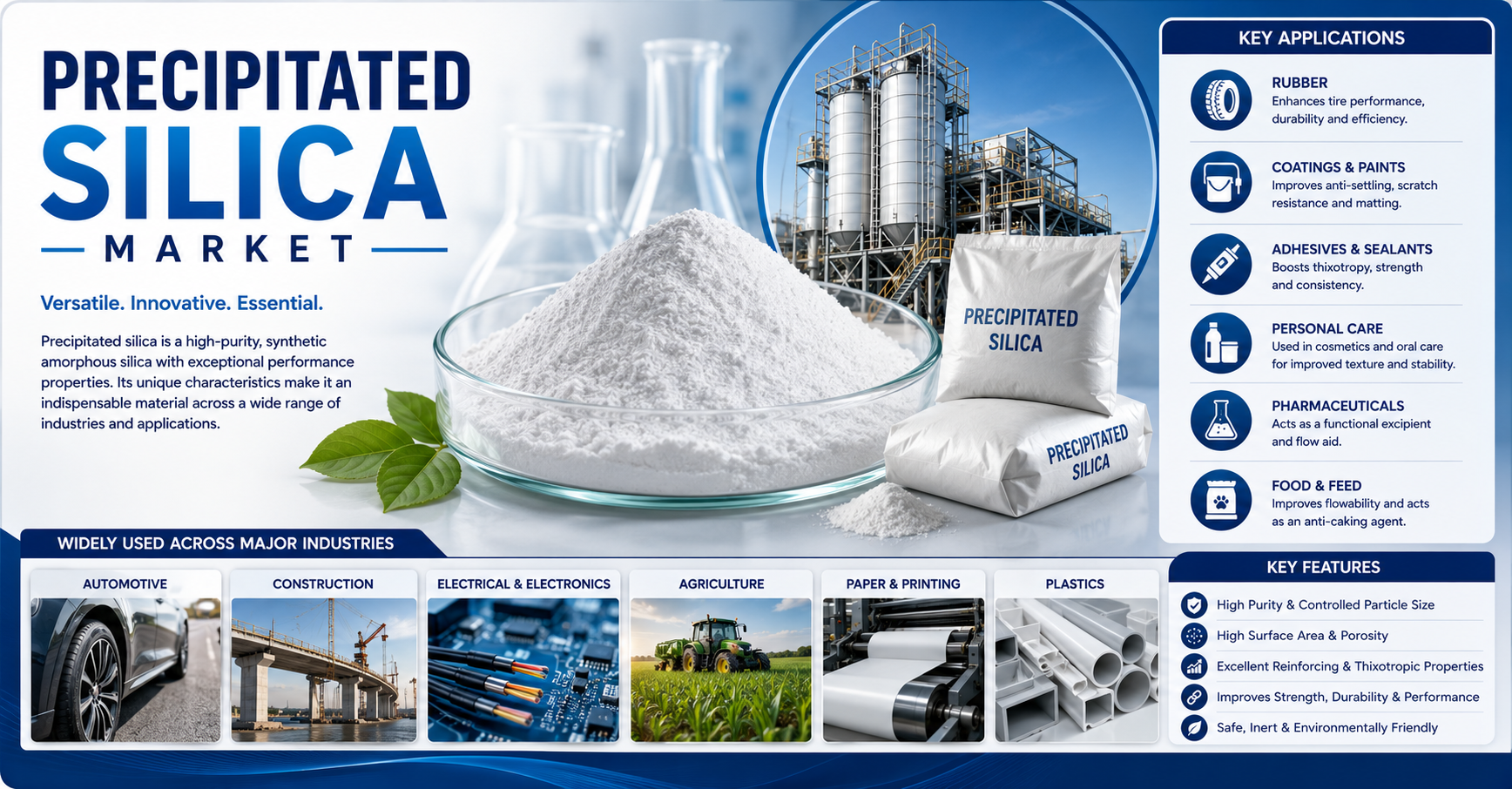

Europe holds the second-largest share at 22.4%, supported by sustainability-driven procurement mandates.
GA, UNITED STATES, July 28, 2026 /EINPresswire.com/ — The global precipitated silica market is entering a decade of steady expansion, propelled by the twin forces of vehicle electrification and evolving food-safety standards. Industry estimates value the market at roughly USD USD 6,120 Million in 2025, with growth to about USD 6,378 Million in 2026 and a climb toward USD 9,250 Million by 2035 — a compound annual growth rate near 4.2% across the forecast window.
Two forces sit at the center of this growth story. First, electric vehicles are driving tire manufacturers toward silica-heavy compounds that reduce rolling resistance and extend battery range. Second, food regulators in Europe and the United States are giving fresh approval to ultra-pure amorphous silica as a safe anti-caking additive, opening new demand in the food and beverage sector.
A Shifting Production Landscape
For decades, wet-process manufacturing — acidifying sodium-silicate solutions — has dominated the industry, and it still accounts for roughly 70% of global output today. But dry-process technology is gaining traction because it uses meaingfully less energy per ton and produces the ultra-high-purity material needed for lithium-ion battery separators. Major producers are responding: large chemical companies have committed hundreds of millions of dollars to expand high-dispersion silica capacity, while others are exploring biomass-derived feedstocks to reduce reliance on traditional sodium silicate.
Download Report Sample Copy: https://www.marketresearchfuture.com/sample_request/2000
Regional Dynamics
Asia-Pacific is both the largest and fastest-growing region, holding more than half of global market share and expanding at a rate that outpaces the global average. Much of this advantage comes from rice-husk-ash valorization projects across India and Southeast Asia, which lower raw-material costs significantly compared to conventional production routes.
Europe ranks second, benefiting from green-tire mandates tied to environmental regulation, while North America rounds out the top three, supported by growing investment in battery-separator research and food-grade product lines. South America and the Middle East & Africa remain smaller but are attracting interest as potential sites for new production capacity, particularly where agricultural residues like rice husks or sugarcane bagasse can serve as low-cost silica feedstock.
Key Growth Drivers
Electric vehicle tire requirements. EV tire compounds typically need substantially more precipitated silica by weight than conventional tires, since the material helps reduce rolling resistance — a critical factor in maximizing driving range. As EV adoption accelerates globally, this translates into meaningful incremental demand for silica producers.
Food-safety approvals. Regulatory bodies in Europe and the U.S. have reaffirmed the safety of highly dispersed amorphous silica for food-contact applications, provided nano-fraction content stays below certain thresholds. This has encouraged food and beverage manufacturers to adopt silica as an alternative to synthetic anti-caking agents.
Battery-grade demand. Lithium-ion battery separators increasingly rely on ultra-fine precipitated silica coatings to improve thermal stability. While this remains a smaller segment today, it represents one of the higher-margin growth opportunities in the industry.
Low-cost feedstock innovation. Government-backed programs in India and parts of Southeast Asia are funding facilities that convert rice husk ash into sodium silicate on-site, giving domestic producers a structural cost advantage over those reliant on imported feedstock.
Purchase Now: https://www.marketresearchfuture.com/checkout?currency=one_user-USD&report_id=2000
Challenges Facing the Industry
Despite the positive trajectory, producers face real headwinds. Wet-process manufacturing is energy-intensive, requiring sustained high temperatures and extensive drying — a cost burden that grew heavier as industrial natural gas prices rose sharply in recent years. Competition from fumed silica, which offers superior performance in some high-value coatings and sealants despite costing several times more per kilogram, also threatens to divert demand in certain applications. Additionally, the sodium-silicate feedstock that underpins most precipitated silica production is subject to price swings driven by soda-ash market volatility.
Segment Highlights
By grade, rubber-grade silica remains dominant, reflecting its central role in tire manufacturing and the ongoing global tire replacement cycle. Food-grade silica, while a smaller slice of the market, is forecast to grow the fastest as clean-label regulations open new application areas.
By form, powder remains the most widely used, prized for its compatibility with existing industrial mixing equipment. Bead form is expanding quickly, driven by demand for controlled-release characteristics in premium oral-care and specialty coating products.
By end use, tires represent roughly a third of total volume, while oral care and cosmetics form a smaller but faster-growing niche, benefiting from consumer premiumization trends in toothpaste and personal-care formulations.
Competitive Landscape
The market is moderately concentrated, with the leading five producers holding roughly half of global installed capacity. Companies with strong positions include major specialty chemical firms known for high-dispersion rubber-grade products, food-grade silica lines, and battery-related innovation, alongside regional players in India and China that have built cost-advantaged production bases through local feedstock access. Mid-tier producers are increasingly carving out defensible niches in ultra-pure and food-grade segments, where regulatory compliance and product purity command premium pricing.
Report Summary: https://www.marketresearchfuture.com/reports/precipitated-silica-market-2000
Looking Ahead
The precipitated silica industry’s future will likely be shaped by several converging trends: continued electric-vehicle adoption driving tire silica loading upward, sustainability-reporting requirements pushing manufacturers toward lower-carbon biomass feedstocks, and gradual digitization of the procurement process through B2B chemical marketplaces. Producers that can combine cost-efficient, sustainable feedstock sourcing with the purity levels demanded by next-generation battery and food applications appear best positioned to capture the market’s growth through 2035.
Related Report
high purity silica market https://www.marketresearchfuture.com/reports/high-purity-silica-market-36032
US Precipitated Silica market https://www.marketresearchfuture.com/reports/us-precipitated-silica-market-14172
green silica market https://www.marketresearchfuture.com/reports/green-silica-market-37379
high silica zeolite market https://www.marketresearchfuture.com/reports/high-silica-zeolite-market-34782
Market Research Future
Market Research Future
+ +1 855-661-4441
email us here
Legal Disclaimer:
EIN Presswire provides this news content “as is” without warranty of any kind. We do not accept any responsibility or liability
for the accuracy, content, images, videos, licenses, completeness, legality, or reliability of the information contained in this
article. If you have any complaints or copyright issues related to this article, kindly contact the author above.

Media gallery